Previous part: Coffee and chain (1)
We continue our little trip along the value chain of coffee with the milling stage.
Milling: Wet milling: this means removal of fruit and husk from the beans. Water is applied to the cherries and they are pulped and fermented. After that they are husked, washed and dried. We now have parchment coffee (or pergamino). Mostly this is as far as the farmer gets, he sells pergamino coffee, based on the world market price. Although the Dry or Natural Method (putting the cherries in the sun to dry) is the simplest and oldest method of preparation, and over 60% of the world’s coffees are processed this way, it has is effect on taste and flavor and most specialty coffee are washed coffees.
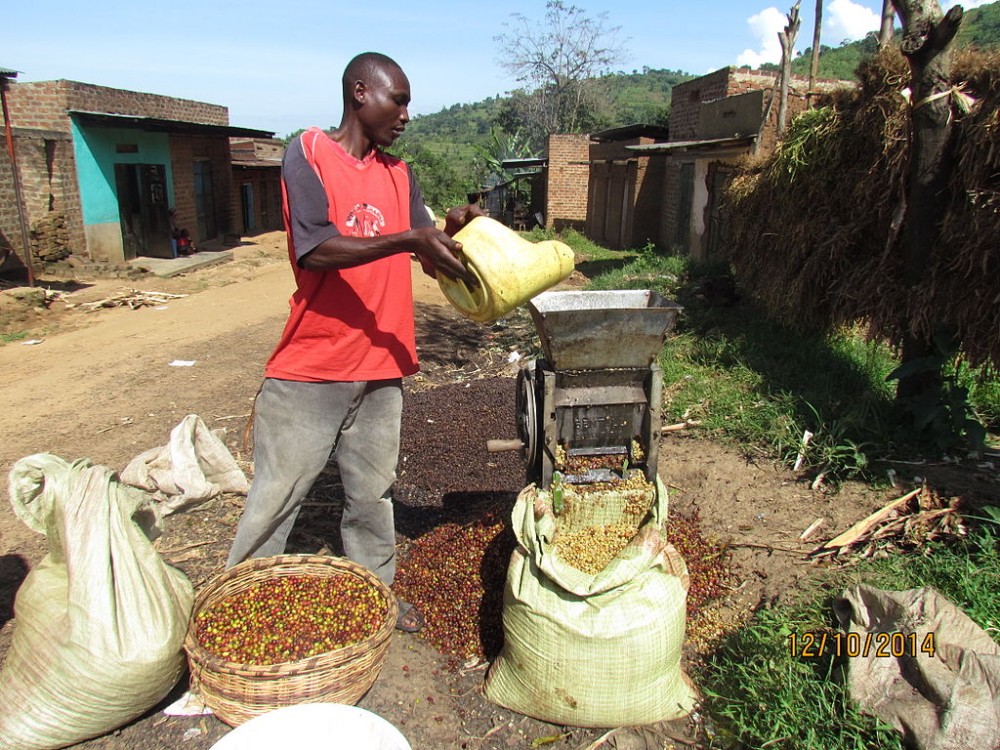 Pulping coffee By Erinamukuta from wikipedia

Transportation: the dried coffee now goes to the dry milling facility, often located in bigger population centers and owned by big producers or international coffee traders.
Dry milling: Before the parchment coffee can be processed, it has to be dried. This can be done in the open (sun) or by machines. Then it moves to the mills. For dry processed coffees, milling involves the removal of the exocarp, mesocarp and endocarp (outside, middle and inner hull) or the entire husk. For washed coffees, only the endocarp need be removed since the others have already been discarded before. After being milled, some beans may be polished to remove any silver skin (endocarp) that remains. The beans are then separated into several sizes by running the beans through sieves with specifically - sized holes and after that manually selected and sorted as green coffee. Green coffee is soft and spongy to the bite and smells grassy and can be stored without loss of quality or taste. Take a look at the next picture.
 Green coffee By Dan Bollinger from wikipedia

Transportation/shipping: The green coffee goes into bags and mostly into containers at some seaport and off they go!
Industrial-Commercial phase:
Roasting, blending and grinding
Roasting brings out the aroma and flavor that is locked inside the green coffee beans.
Roasting is probably the most “scientific” part of the process; it causes chemical changes to take place as the beans are rapidly brought to very high temperatures after which they are quickly cooled to stop the process. Roasted beans are crunchy to the bite, ready to be ground and brewed. Once roasted the beans should be used as quickly as possible before the fresh roast flavor begins to diminish, but as we have seen before, they can be stored for quite a while in vacuum packages. It takes years of training to become an expert roaster as the difference between perfectly roasted coffee and a ruined batch can be a matter of seconds. Coffee roasters create coffee blends to reduce costs, to provide a consistent cup profile and to create unique, signature coffees.
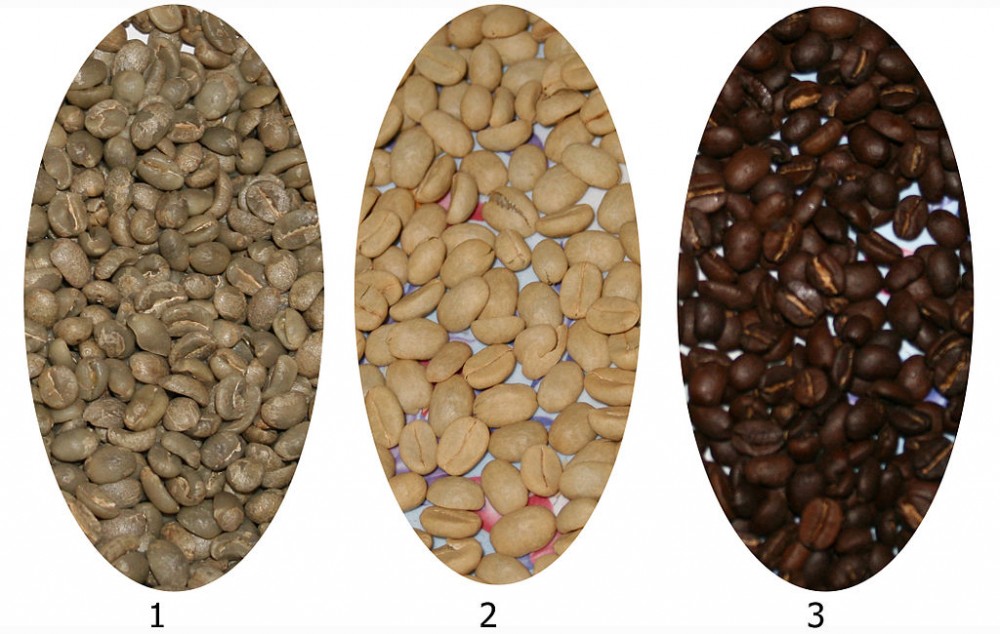
Three stages of coffee roasting. 1. Unroasted coffee beans. 2. Dried and partially roasted. 3. Completely roasted to rich black. By Muhammad Mahdi Karim from wikipedia

Now from here on we have the transportation to wholesale – detail – and finally to the consumers, you and I. And even if everything worked out fine until the coffee gets into our cupboard, we ourselves still can mess up all the previous caretaking of quality at home and end up with a badly made and served coffee.
Of course, what we have seen until now on our little trip along the value chain of coffee is only a glimpse and I have left out a lot of details. In future contributions we will take a closer look at some of the more interesting parts of the overall process. But for now at least we have given you the opportunity to get a general idea of the most prominent parts of the chain and appreciate all the time it took and the work done to get a quality coffee to you.
2017