Value chain is a business management concept that describes all the value adding processes of a product from producer to the final consumer. I’ll start with a few remarks about the value chain and then switch rapidly to the more interesting parts of the chain itself.
At least for the last 20 years roasting companies in the consumer countries purchase raw coffee from farmers for a price below the average cost of growing the coffee. As a result, farmers are selling at a loss while branded coffee sells at a large profit. Because worldwide coffee production has exceeded coffee demand, the vast majority of coffee farmers are at the mercy of the roasting companies. Coffee trees have a life span (years of productivity) between 10 and 50 years, so changing your production is often not a decision a small producer will easily take. One way out of this dilemma is to produce quality or specialty coffees, which obtain better prices. Coffee is exclusively produced in countries in development and almost entirely exported to high income countries. Coffee is one of the world’s most widely traded tropical agricultural commodities. About 25 million small farmers produce 80% of the world’s coffee, and coffee provides a livelihood for a further 100 million people in coffee-producing countries.
But we’ll take a closer look at that at another time. For now let’s get an idea of the parts that build up the value chain, or to say it in other words: what needs to be done to get you your cup of coffee on the table. There are minor differences in every region and country, but the following is a general description based on Central American washed Arabica coffee.
It is only possible to produce good quality and end up with a good cup of coffee if each step of the processing is followed correctly, starting from seed selection to roasting, packaging and shipping, and even the treatment you give it at home. It is not possible to improve quality during the process; at each step quality can only get worse.
On the farm:
Seed selection and nursery: the farmer selects the seeds, grows them in beds, containers or plastic bags which are raised above normal soil level to encourage thorough drainage in a protected nursery environment.
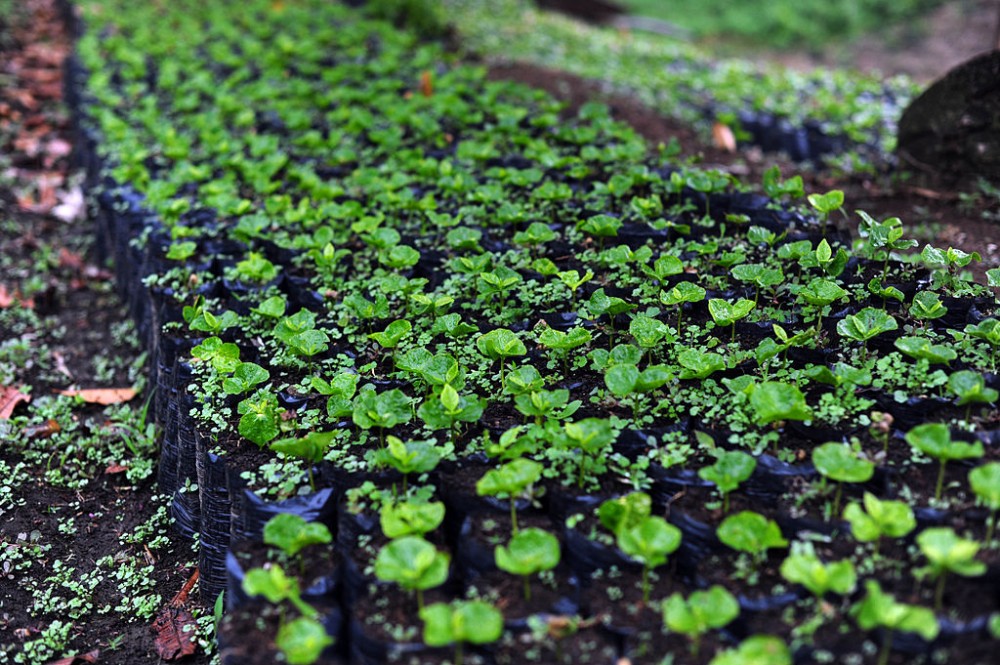
New coffee varieties in a nursery at a coffee farm in Cauca, southwestern Colombia
By Erinamukuta [CC BY-SA 4.0] from Wikimedia Commons

Transplantation: after being nurtured from nine to eighteen months and reaching a height of about 24 inches in the nursery, the new coffee plants are transplanted in the field.
Growing and maintenance: you have to take care of the plants for about 3 years (!) before the first flowers appear and you will have your first, small harvest. With 5 year plants, full production will start (that is quite some time and takes a lot of investments). Small farmers mostly prefer growing local varieties that are more often than not low yielding, but those local varieties are more resistant to plagues, have a longer life span ( from 20 to 50 years) and are less costly.
Harvest: Harvest time, once a year. As the cherries are picked by hand, a lot of workers are needed, and of course they need to be paid (the biggest yearly expense). Only the red (ripe) cherries should be collected and it takes 3 to 5 turns to pick all the beans and leave the tree empty.
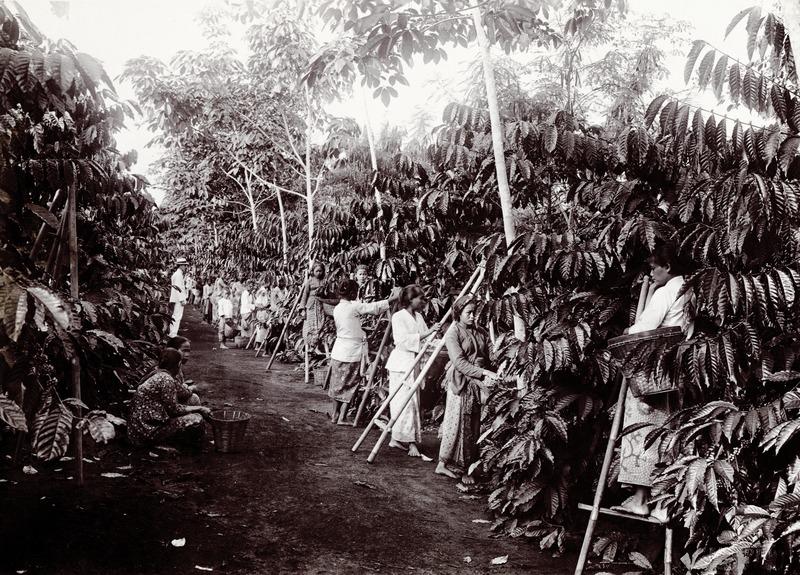
Women picking at a coffee plantation, probably in Java - circa 1915
Ohannes Kurkdjian from Wikipedia
Transportation: The higher up the mountain you are, the better the coffee, but transportation gets to be a problem. Cars (not to mention trucks) often cannot enter the farms so the cherries are transported for miles by people or animals (mules). In some countries the farmers sell the cherries directly, in others they process them on their farm (wet milling) or in a collective facility nearby (often in cooperatives). We will take a look at the milling processes in the next article.
2017