A room with some coffee equipment, coffee cups and beans on a large table, a group of people putting their noses into cups, sniffing, slurping loudly, spitting and taking notes. Little or no conversation, frowning faces, moving spoons … you know you have entered a coffee cupping session! So what is cupping? Cupping is evaluating different characteristics of particular coffee beans, and as tastes change from farm to farm, region to region, country to country and crop to crop, there is a lot to it. But basically cupping is tasting and trying out different coffees.
In a cupping session you compare and contrast coffees against each other, it allows you to get a better understanding of each one. It can be done by professionals (so called Q-grade tasters) or by aficionados, at a laboratory or at home, in a shed in the mountains or at a roasting facility. And it can be done with a lot of different objectives; for quality control, classification or just fun. In a certain way it is like roasting. You can make it as difficult as you want (or need) and it is both an art and a science, but it can be done as easily at home as in a laboratory.
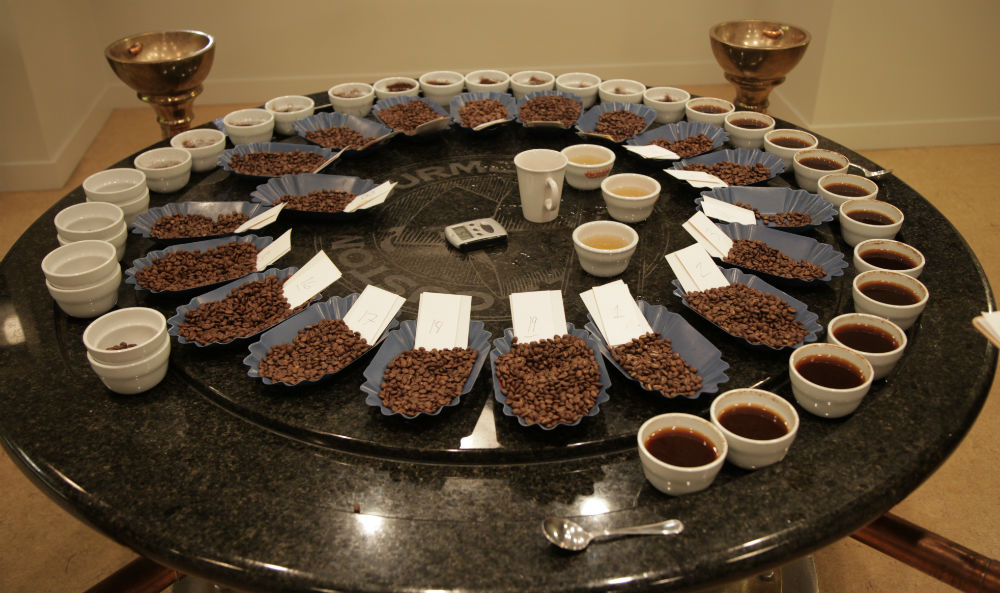 Cupping table
There are quite some videos to be found on the internet of cupping session, but I would like to invite you to see these:
https://www.youtube.com/watch?v=_fGgJUvrOHQ
https://www.youtube.com/watch?v=nr6XyuBnwC0
Coffee cupping starts (or should start) directly after harvest before dry-milling the parchment coffee. This is important because this way farmers know the quality of their product (and can negotiate prices) and if there are problems with the wet-milling process (fermentation problems, too much dirt or other substances near the coffee that get absorbed giving the coffee a bad taste), they can still correct it. Small farmers mostly do not do this, unless they are associated within a cooperative. So you see this kind of laboratories mostly near the farmers and there are not a lot of them.
Producers with their own cupping facility are rare because it means an investment that only works a part of the year (during harvest time). However, some smarter cooperatives use their laboratory to produce and sell their own roasted and ground coffee around the year and/or open a coffee shop so they can have some extra income. In some cases this has really worked out great and quite a lot of my favorite coffees come from this kind of facilities! This way you can get guaranteed single origin coffees with often very unique characteristics. These laboratories normally are quite small and managed with 1 or 2 people with minimum equipment and some basic training, but they are very important to the farmers to know about the quality of their coffee and to make some timely adjustments (if possible) during the production process.
Going up the chain, we come at the next step: the dry-milling facilities. Here cupping becomes a requisite, although not all of them do it. If they have a close relation with the farmers, they can still advise them about the wet-milling, fermenting, storing and transporting processes if there is something wrong with the coffee. However, most of the facilities are more concerned about classifying coffee to be sold and shipped. The big coffee exporting companies have quite impressive laboratories and they use them for quality control of the received coffee (from the farmers), for classification and for quality control of their process. They work around the year as they store the parchment coffee, to be processed evenly during the year (if possible). Without a laboratory they would not know exactly what they are selling or what price to put on it.
 Using your nose
Between dry-milling (which is done in the coffee producing countries) and roasting (which is mostly done in the consuming countries) lies the international trade. They depend on cupping too to know what they buy and sell. Coffee is traded as green coffee, so from now on cupping normally does not start with parchment coffee but with green coffee. It is one step further from the farmer and one step less in the process, and traceability becomes a bit harder.
After that the coffee arrives at the roasters. They cup to understand the basic tastes of coffees as well. Big roasters are often concerned with consistency as they have their trademarks and blends to protect and they have to guarantee a constant quality. They have to understand and decide where different coffees could be slotted into blends not only for one roasting, grinding or brewing method but for all other methods too.
So, should we leave cupping only to the experts? No of course not! We cannot let them have all the fun to themselves. Coffee cupping can be and is done by small local roasters, coffee shops and at home. A cupping session is a social thing and instead of using formal and official recording on forms, just talking about the coffees after the cupping is done serves its purpose as well.
Cupping can be very amusing and fun for even the most novice tasters. Exploring unique tastes of coffees side by side, looking for differences trying to describe the character of a cup can be done by everybody. And remember: There are no right or wrong ways of cupping coffee, so next time we will take a look at the process and how you could do it.
2017