If Maragogype is the elephant, peaberry is the ant (or pea). Peaberry, as the name implies, looks more like a pea than like normal coffee bean. In Spanish speaking countries (Latin America) these beans are known as caracolillo (from caracol – snail house or shell), again because of their shape.
Now first of all, peaberry is not a variety (like Maragogype for example) but a small mutation common to all types and varieties of coffee, that is to say that about 5% of all coffee is peaberry. Normally the cherry of the coffee plant has two seeds (or beans) inside that have grown with flattened, facing sides, each with a crevice in the middle. Sometimes only one of the two seeds is fertilized, and the single seed that was left develops with nothing to flatten it against. This results in a small oval or egg shaped bean. Apart from being the result of a small mutation, there could be a failure in the growth of the endosperm caused by insufficient pollination or (severe) environmental conditions.
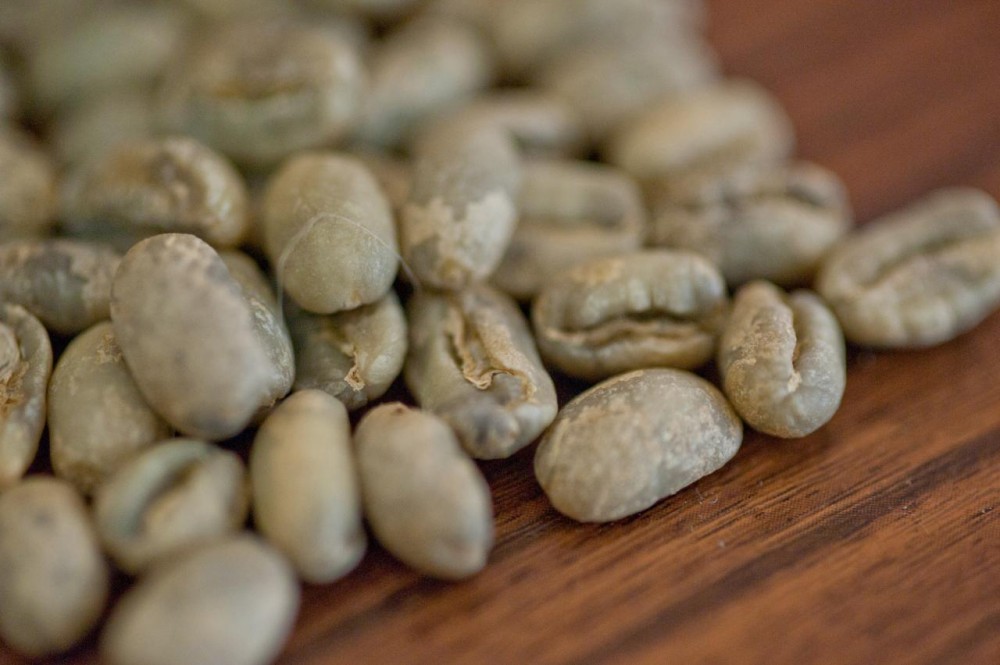 Peaberries
Generally it is said that peaberry has a strong, intense taste and supposedly it produces better coffee than normal beans from the same crop. This is often based on the notion that “nature put all of the good stuff it normally puts into two beans into one”. But you could as easily state the opposite; that peaberries are weak beans produced by half-fertile flowers. One thing however is sure: peaberry coffee tastes a bit different from the coffee from normal beans from the same crop.
One could assume that if about 5% of all coffee is peaberry, it should be possible to encounter a peaberry in the coffee you just bought or you can buy it just about anywhere? Well, as you can notice yourself: that seems not to be the case. Actually, there are only 2 more or less known peaberry coffees: from Tanzania and, more recently from Hawaii (the peaberry variety of Kona coffee) and those are the only ones you could probably find in a specialty shop. Why is that?
As with Maragogype, farmers don’t favour it. As the beans often are smaller they get separated during the wet-milling process and as one peaberry weights less than 2 normal beans, it means less production. Furthermore, peaberries develop when only one of two ovaries in the flower are pollinated or accept pollination and produce only one seed – it is like one child in a species where twins are the norm. Since coffee is self-pollinating (the same flower can impregnate itself) if you have a lot of peaberry, this is a sign of infertility of the plant (not something farmers like of course).
During dry-milling the peaberry ends up with broken and small sized beans and have to be manually selected and separated of the rest of the beans that are normally not destined for export. So if you do not have a specific buyer for it, it’s not worth the trouble.
 Peaberry – close up image
By Ragesoss [CC BY-SA 3.0 (https://creativecommons.org/licenses/by-sa/3.0)
or GFDL (http://www.gnu.org/copyleft/fdl.html)], from Wikimedia Commons
Peaberry beans roast differently from the normal berry beans so to obtain an even roast they should be separated, not something roasters like to do a lot. But if a roaster gets a whole batch of peaberry, things are quite different. The beans should roast better than flat berries because of their round shape which allows them to easily roll inside the roasting chamber and the higher bean density may improve heat transfer in the roasting process.
So in nature peaberries are not exceptional, but for us they are not easily available, which always makes it interesting to try it out. Just don’t expect too much or something totally different. And thinking about it now ... I’ll go out and try to find some Maragogype peaberry! That should be interesting: a giant peaberry!
Like to read more about peaberry? I can recommend “The Tanzania Peaberry Mystery” (https://www.coffeereview.com/the-tanzanian-peaberry-mystery) as a good read!
2017