Selling coffee below cost price for years and still go on producing? How and why do they do it, taking into account that some 80 or 90 percent of the producers are micro or small farmers? If you come to think about it, it is nothing short of a miracle we still can drink and enjoy our favorite morning beverage each day!
However, you have to take into account that coffee productions takes place in the third world, the developing countries. Poverty has another meaning in that context and actually you must have seen/lived it to fully understand it. Coffee producing areas are often found in the most inaccessible, poorest rural parts in the mountains of tropical countries (there are exceptions of course). Coffee is a cash-crop in a part of the world were money and efficient and functional economic relations have not yet totally entered and/or developed. Of course, each year this is less true in an internationalizing world, but yet, it is still true.
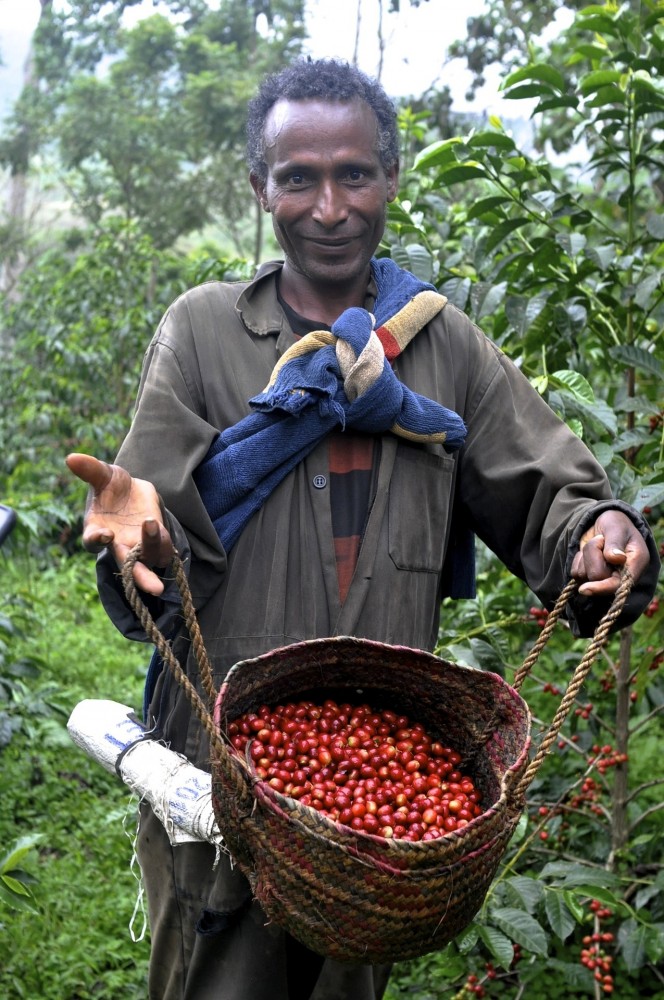 Ethiopian coffee picker
Coffee being a cash-crop means the small farmers depend on it to get money to pay for medicine, school for the kids, agro-chemicals and means of production; that is to say all those payments that are not daily expenses. The food-crops they normally produce besides their coffee often have a shorter cycle, can be consumed, bartered or sold locally. Cash-crops are used as a kind of piggy-bank: once a year they get a certain amount of cash they can count on and they can use it as a counterpart for loans. Smart and survivalist farmers have diversified farms, several crops they can harvest the better part of the year, so when one harvest fails, they can resolve with the other one.
When we talk about producing coffee below cost, we are talking about the average cost. Very small farmers tend to have costs that are quite below the average because their production is not technologically enhanced and, more often than not, they do not include their wages or the wages of family (or community) members in the costs. It’s nice to have a big family or a lot of friends during harvest.
But losing money on your coffee (or making very little), year after year, is not funny. That’s why a lot of Columbian farmers switched to cocaine, it’s more profitable. But most small farmers are not likely to have that kind of alternative at hand and most of them and their families have cultivated coffee on that piece of ground for generations, coffee is what they know how to grow and they often are quite proud of that (and their coffee). And, of course, it is a kind of pity when you have to cut down the plants of your plantation that your father and grandfather took care of and that still have years of potential production ahead.
 Columbian coffee bags
So they can diversify, keep expenses low, do more manual labor to substitute chemicals, not paying yourself or family, but of course these are no real solutions. Structurally, they should just be paid more for their product, but that is not going to happen any day soon, so the other option is to try and get access to the gains further up the value chain. They can improve the quality of their coffee and/or process it.
Improving the quality of your coffee: you can try to optimize your production process and try to produce a specialty coffee. That is nearly impossible if your farm isn’t at a certain altitude and you still have to sell your coffee to someone that is paying more for quality coffee. Often coffee is already sold before harvest (to pay for chemicals and other expenses) and at harvest time the buyers buy in bulk without making difference in quality. And then of course you can get your coffee certified, but this takes a lot of time and money.
Processing your product also requires a lot of money and most farmers don’t have the money or quantities of coffee required to make it work (buy a dry-milling facility for instance).
To overcome this kind of problems and obstacles, one way out is to start or join a cooperative, which will be another theme in this series.
2017