
Millions of people start their day with a nice cup of coffee, but how much do we know about coffee? Over two billion cups of coffee are drunk around the world every day and more than 25 million families rely on growing coffee for a living. Many people are developing an awareness and appreciation of the varied taste profiles of coffee, but then again: What do we know about the people who grow coffee, how and where it is grown, what varieties there are and what makes a specialty coffee? What is needed to get from seedlings to your cup? Well today we are going to start a series of articles that will show you your way into the coffee world.
Isn’t coffee just coffee, no matter what name they put on it? Well, yes, in the sense that almost all coffee is grown from one of two different species of plants — and no, in the sense that there are a large number of factors all having a hand in how that cup actually tastes.
First, let’s talk about what coffee actually is. The ever-present bean we’re all familiar with begins life inside the cherrie of the Coffee plant as a seed. The cherries are picked, processed, and dried — then the seeds are roasted, creating the coffee bean we see in the bulk bins at the supermarket.
A coffee plant usually starts to produce flowers three years after it is planted and it is from these flowers that the fruits of the plant, berries or cherries, appear. There are several flowering periods so about half a year you can see the plant flowering with nice little white flowers. The cherries ripen around six to eight months after the flowering, by changing color from green to red, and it is at this time that they should be harvested. In most coffee-growing countries, there is one major harvest a year; though in other countries (mostly south and central American), there are two or more flowerings a year and so there several or one prolonged harvest(s).
.jpg)
The cherries, first green, when turned red are harvested. In most countries, the coffee crop is picked by hand, a labor-intensive and difficult process, though in places like Brazil, where the landscape is relatively flat and the coffee fields are immense, the process has been mechanized. Harvest by machine is always strip picked (all coffee fruit is removed from the tree, regardless of maturation state), selective picking can only be done by hand. Selective picking actually is a requisite for quality coffee.
Depending on which country you are in and what variety we have, the berries are either pre-processed using the wet-process or the dry-process to separate the bean from the remainder of the pulp. After that the beans are dry-milled and what we then have is called “green coffee”. The green coffee is mostly exported and send to roasters around the world where it is toasted and grinded.
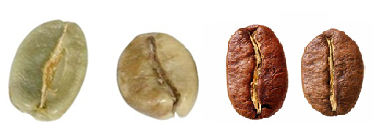
Green and roasted Arabica and Robusta
If there is one more important fact concerning coffee, it would be that its quality never improves: you can only spoil it. This is an important starting point of the “total quality” concept. During every step, from selecting the seeds, choice of variety, planting the seedlings, during fermentation, drying, milling and, of course, toasting, the quality can only get worse. Even the way you serve your coffee, the water you use and its temperature can make the difference between just coffee and a good cup of coffee. The concept of “total quality” will be our leading guide throughout this series of articles about coffee and next time we will look into the main varieties of the coffee plant: Arabica and Robusta.
2017